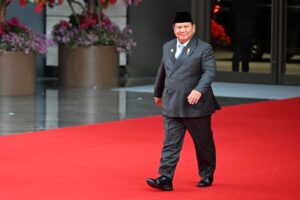
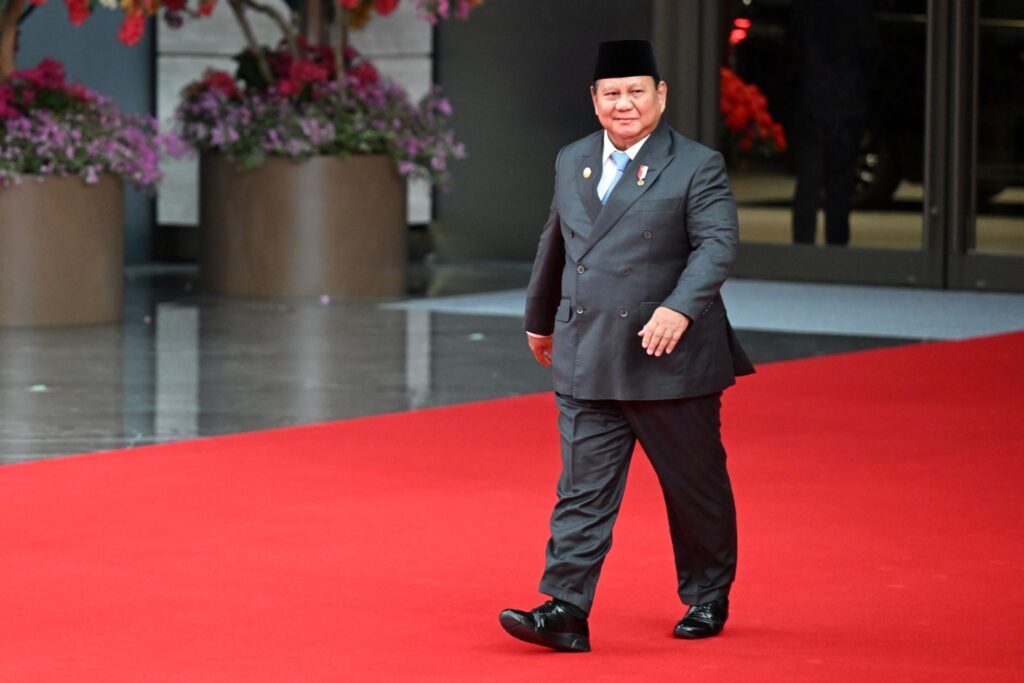
Shenzhen, November 19, 2026 — President Prabowo Subianto on Thursday voiced Indonesia’s hopes for a historic gathering of the leaders of the United States, China and Russia at the 33rd APEC Economic Leaders’ Meeting in Shenzhen, China, saying their leadership could shape the future of the world.
The summit, held on Nov. 18-19, brought together US President Donald Trump, Chinese President Xi Jinping and Russian President Vladimir Putin. The three leaders also held their first trilateral talks on the sidelines of the meeting, resulting in what was described as a “joint declaration of peace”.
Prabowo said he hoped the three leaders would exercise leadership and statesmanship to help address global challenges, noting that their decisions would determine what he called “the destiny of the world”.
“I would like, at this moment, also to express our admiration and our hopes for the historical meeting that is taking place at this APEC summit between the three leaders of the three great powers of the world, President Xi Jinping, President Trump, and President Putin,” Prabowo said during his address to the summit.
“I would like to say the hopes and the prayers of billions of people are placing their hopes and prayers on your shoulders,” he added.
Prabowo’s remarks reflected Indonesia’s longstanding free and active foreign policy, which calls for the country to engage in global affairs to promote peace, justice and the resolution of international challenges. He has repeatedly underscored this approach, invoking the principle that “one thousand friends are too few, one enemy is too many”.
Indonesia has maintained relations with all three powers while seeking closer cooperation in areas including investment, trade, defense and energy.
At a special ASEAN-US summit in Manila on Tuesday, Trump praised Prabowo as a “great leader” and highlighted defense cooperation between the two countries. Meanwhile, at the APEC summit, Putin expressed Russia’s interest in expanding economic ties with Indonesia, describing the country as one of the largest and fastest-growing economies in Asia and the world.
Prabowo further called on major powers to expand cooperation with other countries in the Global South, saying stronger partnerships would help pave the way for shared prosperity.
“We call for more sharing of technology, more investment, and real partnerships with the global South. Cooperation is not charity; it is the path to our common prosperity,” Prabowo said.
Therefore, he also welcomed this year’s APEC priorities of openness, innovation and cooperation, saying they offered pathways to prosperity across the Asia-Pacific region.
Prabowo said Indonesia supported openness but stressed that it must be fair, predictable and grounded in a rules-based multilateral trading system. Openness without fairness, he warned, could create dependency.
He also argued that developing economies should not remain mere consumers of technology but should have an equal voice in shaping emerging technologies, including artificial intelligence (AI). Therefore, Prabowo called for broader access to AI, skills development and research opportunities for developing countries.
“Innovation must not become a new wall between the rich and the poor,” he added.
Prabowo said the principles of fairness and inclusivity he advocated on the global stage were also being pursued at home, as Indonesia sought to build a more resilient, productive and inclusive economy through a series of national transformation measures.
He cited efforts to modernize fishing villages and develop village cooperatives as new economic hubs to boost rural productivity. The government had also accelerated its downstreaming drive to produce higher-value goods and create jobs.
In the education sector, Prabowo pointed to efforts to introduce digital technology in classrooms to improve access to education, particularly in frontier, outermost and underdeveloped regions.
“Indonesia is also writing its own story of transformation. At the heart of this is a commitment to building a resilient, productive, and more inclusive economy. And that story begins with our people,” he said.