Jakarta, November 4, 2026 — Indonesia will use the upcoming United Nations climate conference in Antalya, Türkiye, as a platform to advance its energy transition, focusing on securing international climate financing and ensuring that the shift to cleaner energy is fair and benefits local communities.
Environment Minister Jumhur Hidayat said on Wednesday that Indonesia would incorporate these priorities into its six negotiating tracks at the 31st Conference of the Parties (COP31) to the United Nations Framework Convention on Climate Change (UNFCCC), scheduled for Nov. 9 to 20.
The priorities include promoting a just energy transition and expanding access to international climate financing through mechanisms such as the Green Climate Fund (GCF), the Global Environment Facility (GEF) and the Adaptation Fund.
Jumhur said the priorities were part of Indonesia’s broader efforts to step up climate action and meet its commitments under the Paris Agreement, as outlined in its Second Nationally Determined Contribution (Second NDC), submitted to the UNFCCC on Oct. 27, 2025.
The Second NDC projects that Indonesia’s greenhouse gas (GHG) emissions will peak in 2030 at between 1.35 and 1.49 gigatons of carbon dioxide equivalent (Gt CO₂e), before declining to between 1.26 and 1.49 Gt CO₂e by 2035 under different low-carbon development scenarios.
The document sets out Indonesia’s contribution to the Paris Agreement, which seeks to keep the rise in the global average temperature well below 2 degrees Celsius above pre-industrial levels while pursuing efforts to limit the increase to 1.5 degrees Celsius.
Jumhur said Indonesia remained committed to global climate action but stressed that emissions reduction efforts must be fair and take the country’s development needs into account.
“Our priorities are energy affordability, workers’ welfare and protection of local communities. We also oppose unilateral measures that disadvantage developing countries,” Jumhur said at a press briefing jointly held by the Government Communication Agency and the Environment Ministry.
He added that Indonesia would also follow up on the outcomes of the global stocktake—the five-yearly assessment that reviews collective progress toward achieving the goals of the Paris Agreement—at the conference.
Jumhur also emphasized that Indonesia supported efforts to raise ambition and strengthen the implementation of its NDC, but stressed that greater ambition should not create obligations beyond those stipulated in the Paris Agreement. Such efforts, he added, must be supported by financing, technology transfer and capacity-building from developed countries.
“On the Paris Agreement and NDCs, ambition increases in accordance with the principle of Common but Differentiated Responsibilities and Respective Capabilities (CBDR-RC) and national circumstances,” he said.
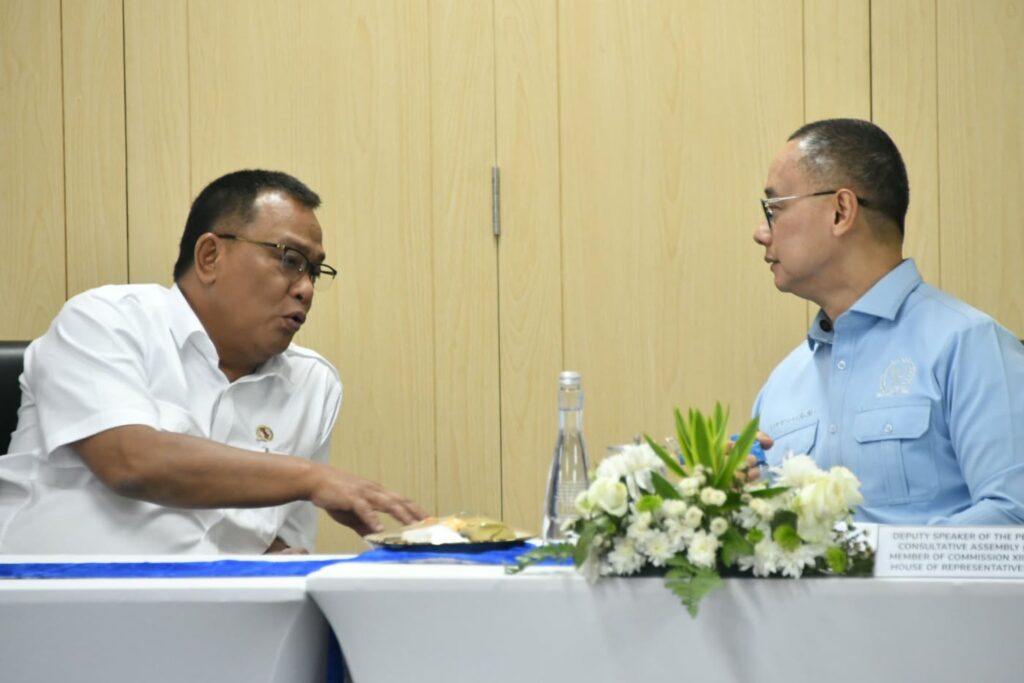
Speaking at the same event, Deputy Speaker of the People’s Consultative Assembly Eddy Soeparno said Indonesia would use COP31 to reaffirm its energy transition as a cornerstone of its national development agenda.
He said the transition could help the country pursue its 8 percent economic growth target while building a greener, more sustainable economy and reducing carbon emissions. It was also crucial to strengthening national energy security amid global uncertainty and disruptions to energy markets, he added.
To support the transition, Eddy said Indonesia already had a policy framework to expand the share of renewable energy in its power mix through the 2025–2034 Electricity Supply Business Plan (RUPTL). Under the plan, the country aims to add 42.6 gigawatts (GW) of new and renewable energy capacity, accounting for around 61 percent of planned additional power generation capacity by 2034.
Eddy also cited the government’s plan to develop 100 gigawatt-peak (GWp) of solar power capacity as part of efforts under President Prabowo Subianto to phase out diesel-fired power plants across the country.
He said Indonesia would showcase these initiatives at COP31 to highlight its climate action and progress toward meeting its Paris Agreement commitments.
“We aim to position the energy transition as one of our key focuses, and this is also a key message that we would like to present at COP31,” he said.
“COP31 presents us an opportunity to present to the global community on what Indonesia has achieved so far, and what Indonesia tries to achieve in the very near future,” Eddy added.
Eddy said Indonesia would also highlight its recent waste-to-energy initiatives at the conference, presenting them as part of efforts to address the country’s waste management challenges while reducing carbon emissions.
He noted that Indonesia generated 56.63 million tonnes of waste in 2023, around 61 percent of which was unmanaged. To address the problem, the government plans to develop waste-to-energy facilities across 33 designated sites, which could help tackle waste while providing clean electricity.
“This is something that we would like to highlight during the events at COP31,” he added.