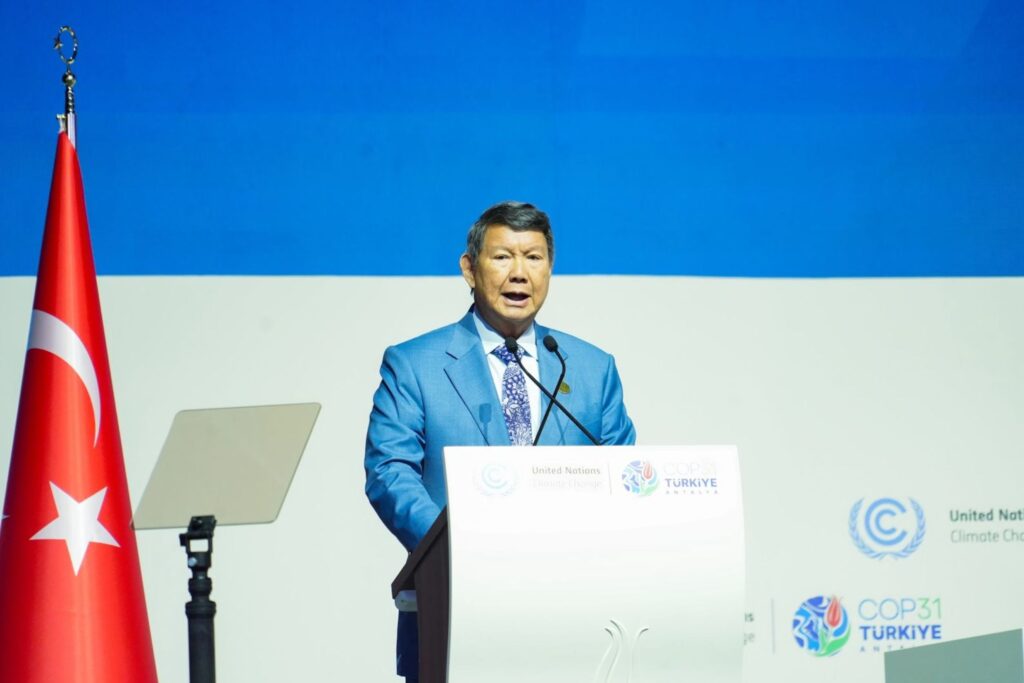
Antalya, Friday 13, 2026 — Indonesia on Thursday reaffirmed its commitment to balancing climate action with national development at the 31st Conference of the Parties (COP31) to the United Nations Framework Convention on Climate Change (UNFCCC) in Antalya, Türkiye.
The message, delivered by Presidential Special Envoy for Climate and Energy and head of Indonesia’s delegation to COP31 Hashim Djojohadikusumo during the conference’s Leaders’ Summit, underscored President Prabowo Subianto’s vision that economic growth should not come at the expense of environmental protection.
“We will not choose between development and climate action. President Prabowo Subianto’s vision is clear: We must deliver both,” Hashim said.
“Indonesia is committed to accelerating economic growth while strengthening food and energy security, creating jobs and developing higher-value industries,” he added.
Hashim said Indonesia took climate action seriously because its status as an archipelagic nation made it particularly vulnerable to climate-related challenges, including rising sea levels and extreme weather. This made it imperative for the country to take concrete steps toward achieving net-zero emissions by 2060 or sooner, as outlined in its Second Nationally Determined Contribution (NDC).
The Second NDC projects that Indonesia’s greenhouse gas (GHG) emissions will peak at between 1.35 and 1.49 gigatons of carbon dioxide equivalent (Gt CO₂e) in 2030, before declining to between 1.26 and 1.49 Gt CO₂e by 2035 under different low-carbon development scenarios.
At the same time, Indonesia must continue pursuing its development agenda to boost economic growth, improve prosperity and strengthen national resilience. Hashim stressed, however, that these efforts should not come at the expense of environmental protection, underscoring the need to align national development priorities with climate action.
He said Indonesia had translated, and would continue to translate, these priorities into concrete measures across several sectors.
In the energy sector, Hashim said Indonesia was accelerating its transition to cleaner energy, including through plans to develop 100 gigawatts (GW) of solar power capacity to reduce reliance on fossil fuels.
To achieve food self-sufficiency, he said Indonesia had decided against expanding agricultural activities into forested areas, particularly primary forests, and would instead focus on improving productivity on degraded land.
For communities whose livelihoods depend on forests, Indonesia had introduced a social forestry program that provided more than 1.4 million families with access to over 8 million hectares of forest to manage under sustainable practices, he noted.
Indonesia had also designated 400,000 hectares as customary forests to recognize indigenous communities as the primary beneficiaries and support their sustainable livelihoods, with plans to expand the coverage to 1.4 million hectares by 2029.
“These efforts build and strengthen national resilience, which in turn contributes to global climate action,” he added.
He also said Indonesia would continue strengthening efforts to mitigate environmental damage, describing such measures as essential to national development, community protection and the country’s responsibility to help safeguard the global environment.
Hashim cited efforts to tackle forest and land fires, saying Indonesia planned to increase the number of forest rangers and wildfire response personnel from 8,000 to 70,000, while also strengthening their capacity. The country was also committed to strengthening prevention, restoration and law enforcement efforts, while working closely with regional partners to address the wider impacts of forest and land fires, including transboundary haze.
Indonesia would also invest heavily in conservation to protect its forests and biodiversity, including endangered orangutans, elephants and Sumatran tigers.
However, Hashim stressed that the climate challenge is also shared by all nations. Therefore, he called on developed countries to step up their efforts to address climate change, including by taking the lead in delivering the New Collective Quantified Goal (NCQG) of at least USD 300 billion annually by 2035 and supporting technology transfers.
Indonesia, he added, was ready to work with all partners in a spirit of mutual respect and shared responsibility. The country welcomed various forms of climate finance, including mechanisms based on carbon pricing, but stressed that such funding must be accessible.
“Climate finance must be accessible, affordable and aligned with national priorities. Cooperation must respect national circumstances and deliver results,” he said.
“Let COP31 be remembered not for more promises, but for turning plans into action, giving brighter hope and future to the world and mankind,” he concluded.